
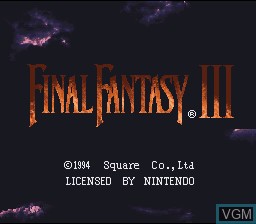
Final Fantasy III (3) - SNES


Final Fantasy VI was released to critical acclaim and is seen as a landmark title for the role-playing genre; for instance, it was ranked as the 2nd best RPG of all time by IGN in 2017. Its SNES and PlayStation versions have sold over 3.48 million copies worldwide to date as a stand-alone game, as well as over 750,000 copies as part of the Japanese Final Fantasy Collection and the North American Final Fantasy Anthology. Final Fantasy VI has won numerous awards and is considered by many to be one of the greatest video games of all time.
It was ported by Tose with minor differences to Sony's PlayStation in 1999 and Nintendo's Game Boy Advance in 2006, and it was released for the Wii's Virtual Console in 2011. In 2017, Nintendo re-released Final Fantasy VI as part of the company's Super NES Classic Edition.[1] The game was known as Final Fantasy III when it was first released in North America, as the original Final Fantasy II, Final Fantasy III, and Final Fantasy V had not been released outside Japan at the time (leaving IV as the second title released outside Japan and VI as the third). However, most later localizations use the original title.

Gameplay
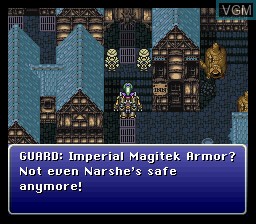
The game's plot develops as the player progresses through towns and dungeons. Town citizens will offer helpful information and some residents own item or equipment shops. Later in the game, visiting certain towns will activate side-quests. Dungeons appear as a variety of areas, including caves, forests, and buildings. These dungeons often have treasure chests containing rare items that are not available in most stores. Dungeons may feature puzzles and mazes, with some dungeons requiring the player to divide the characters into multiple parties which must work together to advance through the dungeon.[2]
Combat
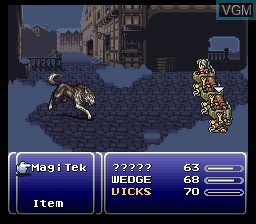
Combat in Final Fantasy VI is menu-based, in which the player selects an action from a list of such options as Fight, Magic, and Item. A maximum of four characters may be used in battles, which are based on the series' traditional Active Time Battle (ATB) system first featured in Final Fantasy IV. Under this system, each character has an action bar that replenishes itself at a rate dependent on their speed statistic. When a character's action bar is filled, the player may assign an action. In addition to standard battle techniques, each character possesses a unique special ability. For example, Locke possesses the ability to steal items from enemies, while Celes' Runic ability allows her to absorb most magical attacks cast until her next turn.[3]
Another element is the Desperation Attack, a powerful attack substitution that occasionally appears when a character's health is low. Similar features appear in later Final Fantasy titles under a variety of different names, including Limit Breaks, Trances, and Overdrives.[4] Characters are rewarded for victorious battles with experience points and money, called gil (Gold Piece (GP) in the original North American localization). When characters attain a certain amount of experience points, they gain a level, which increases their statistics. An additional player may play during battle scenarios, with control of individual characters assigned from the configuration menu.[3]
Customization
Characters in Final Fantasy VI can be equipped with a variety of weapons, armor and, particular to this entry, powerful accessories known as "Relics". Weapons and armor increase combat capability mostly by increasing statistics and adding beneficial effects to attacks. By comparison, Relics have a variety of uses and effects, are almost entirely interchangeable among party members, and are extended in sophistication to alter basic battle commands and exceed normal limitations of the game's systems.
Although in Final Fantasy VI only two playable characters start the game with the ability to use magic, magic may later be taught to almost all other playable characters through the game's introduction of magicite and the Espers that magicite shards contain. "Espers" are the game's incarnation of the series' trope of "summons", powerful monstrous beings, many of which are recurring throughout the series, such as Ifrit, Shiva, Bahamut and Odin. Besides those returning from previous entries, Final Fantasy VI features approximately two dozen of them in total, with more added to later versions of the game.
The setting and plot of the game revolve heavily around Espers and their remains when deceased, which are referred to as "magicite". Each piece of magicite has a specific set of magic spells that a character can learn when they are equipped with it in the menu. Additionally, some pieces of magicite grant a statistical bonus to a character when they gain a level. Finally, when a character equips a piece of magicite, they may summon the corresponding Esper during battle.[5]
We have a 30-day return policy for all Brand New Items, which means you have 30 days after receiving your item to request a return.
We have a 30-day replacement policy for all Pre-Owned Items, which means you have 30 days after receiving your item to have any malfunctioning part replaced with another of the same item.
To be eligible for a return of a Brand New Item, your item must be in the same condition that you received it, unworn or unused, and in its original packaging. You’ll also need the receipt or proof of purchase.
To start a return, you can contact us by calling the store at (518) 823-4471. If your return is accepted, we can either send you a return shipping label to your email address used for the purchase, as well as instructions on how and where to send your package, we will deduct the cost of the return shipping label from your final return value. Alternatively, you can use your own shipping method to return the items. Any items sent back to us without first requesting a return will not be accepted.
You can always contact us for any return question by calling the store at (518) 823-4471.
Damages and issues
Please inspect your order upon reception and contact us immediately if the item is defective, damaged or if you receive the wrong item, so that we can evaluate the issue and make it right.
Exceptions / non-returnable items
Certain types of items cannot be returned, like perishable goods (such as food, flowers, or plants), custom products (such as special orders or personalized items), and personal care goods (such as beauty products). We also do not accept returns for hazardous materials, flammable liquids, or gases. Please get in touch if you have questions or concerns about your specific item.
Unfortunately, we cannot accept returns on sale items or gift cards.
Refunds
We will notify you once we’ve received and inspected your return, and let you know if the refund was approved or not. If approved, you’ll be automatically refunded on your original payment method. Please remember it can take some time for your bank or credit card company to process and post the refund too.
 '
' '
' '
' '
' '
'